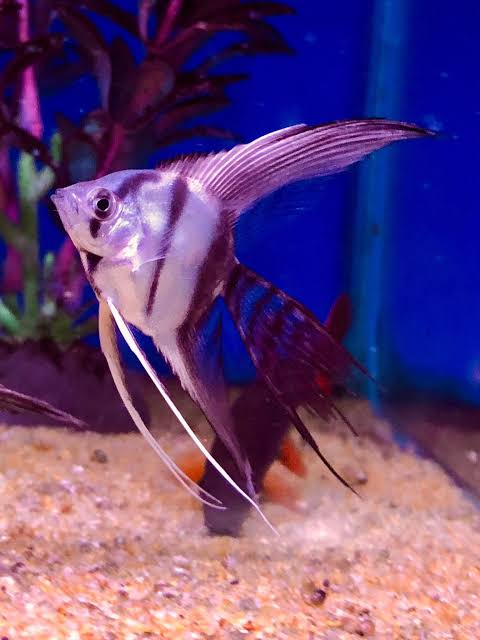
The Blue Veiltail Angelfish (Pterophyllum scalare) is a highly sought-after, selectively bred domestic color morph of the classic freshwater angelfish, celebrated for combining a striking metallic blue sheen with exceedingly long, flowing fins.
🧬 Genetic & Appearance Breakdown
• The Blue Trait: Most high-quality variants are derived from the Philippine Blue (PB) line. This is a recessive genetic trait where the fish expresses an iridescent, reflective steel or silver-blue coloration rather than a pigment. Its vibrancy depends heavily on high-quality diet and bright, daylight-spectrum lighting; under dim conditions, they can look dull or gray.
• The Veiltail Finnage: The "veil" gene is a recessive trait that drastically elongates the dorsal, anal, and caudal fins, creating a cascading, silk-like appearance as they glide.
• Sub-Varieties: You will often find this fish in combinations like the Blue Marble Veiltail (mosaic black-and-silver with blue iridescence), Blue Zebra Veiltail (prominent dark vertical stripes), or the Blue Blushing Veiltail (translucent gill plates showing pinkish-red "cheeks").
🏠 Aquarium & Care Requirements
Because of their extreme fin modification, Blue Veiltails are slightly more delicate than standard-finned angelfish.
• Tank Size & Height: Adults can reach up to 15 cm in body length and over 20 cm in vertical height including their fins. They require a tall aquarium of at least 100 to 180 litres to swim comfortably without scraping their fins.
• Water Parameters: They thrive in clean, highly stable tropical conditions. Ideal temperatures are 26°C to 28°C with a pH range of 6.5 to 7.5.
• Aquarium Decor & Flow: Avoid sharp rocks or coarse decorations that can tear their trailing fins, which leaves them vulnerable to bacterial infections like fin rot. Use smooth driftwood and tall plants (like Amazon Swords) to provide natural sight breaks. Use gentle, efficient biological filtration; excessively strong currents must be avoided so the fish aren't constantly fighting a heavy drag on their fins.
🤝 Diet & Tank Mates
• Diet: As omnivorous cichlids, they should be fed a varied diet of high-quality flakes or granules supplemented with protein-rich foods like frozen bloodworms, brine shrimp, and daphnia to maximize their iridescent blue color.
• Tank Mates: While peaceful when young, they are still cichlids and will become territorial as they mature or form breeding pairs. Strictly avoid fin-nipping tank mates (such as Tiger Barbs), which will ruthlessly shred a veiltail's finnage. Also avoid tiny fish (like juvenile Neon Tetras) that can fit inside an adult angelfish's mouth. Excellent companions include peaceful medium-sized tetras, Corydoras catfish, Bristlenose Plecos, and peaceful gouramis.
SKU: AN-0138