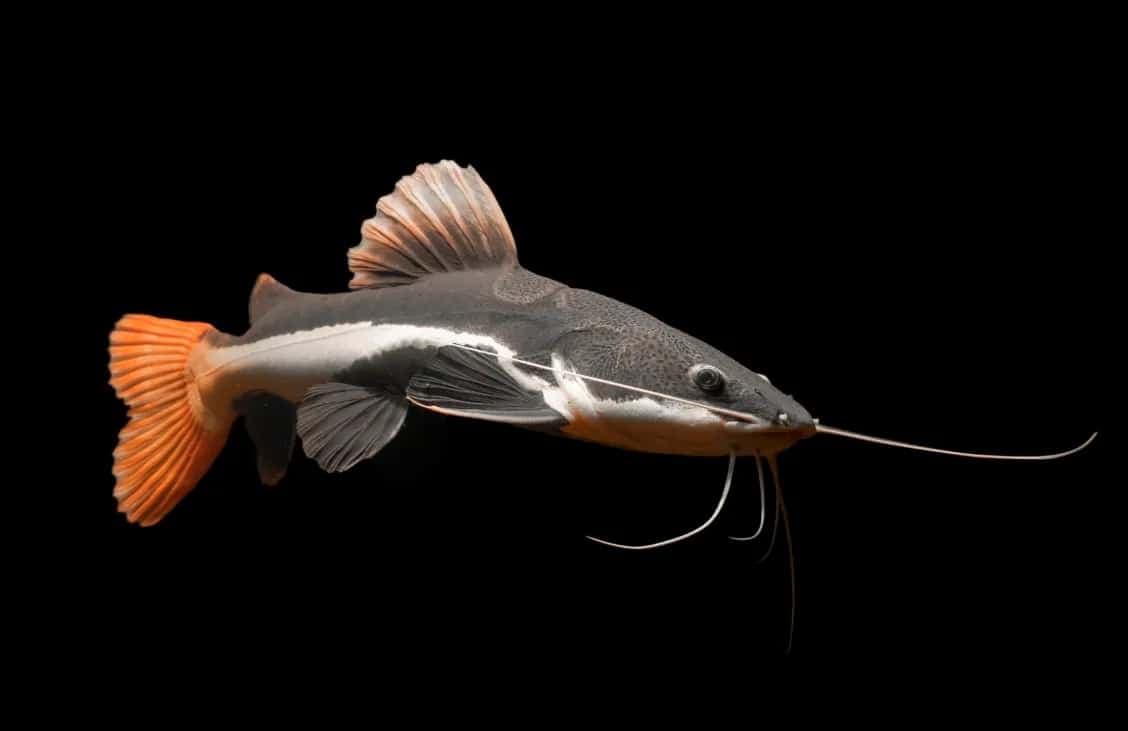
The South American Redtail Catfish (Phractocephalus hemioliopterus) is a predatory giant of the freshwater world, renowned for its striking black-and-white coloration, long barbels, and vibrant orange-red tail fin. While juveniles are frequently sold in the aquarium trade at small sizes, this "monster fish" grows exceptionally fast and can exceed 1.5 metres in length and weigh over 80 kilograms, making it entirely unsuitable for standard home aquariums.
🐟 Species Overview
• Native Range: Amazon, Orinoco, and Essequibo river basins in South America.
• Local Names: Known as Pirarara in Brazil and Cajaro in Venezuela.
• Anatomy: Their massive heads make up roughly one-third of their body length, housing an expansive mouth equipped with sandpapery pads of tiny teeth used to grip—rather than chew—prey.
• Sensory System & Communication: Lacking scales, they rely on highly sensitive chemical reception cells in their long whiskers (barbels) to navigate and hunt in dark, murky river bottoms. They can also communicate or warn off threats by clicking bones together to make a distinct squeaking or grunting noise.
🏠 Aquarium Care & Constraints
Keeping a Redtail Catfish is a serious, long-term commitment best left to advanced hobbyists or public installations.
• Tank Size: A minimum tank size of 2,000 to 10,000 litres is required for a fully mature adult. Standard glass home aquariums will easily be outgrown within the first year due to their explosive growth rate.
• Water Conditions: They require tropical temperatures between 22–26°C, a pH of 6.0–7.5 (tolerating no higher than 7.2), and massive, heavy-duty biological filtration to manage the bioload of a large carnivore.
• Scaleless Sensitivity: Because they lack scales, they are highly sensitive to aquarium medications. If treatment is ever necessary, doses must typically be cut in half to prevent chemical burns or death.
• Diet & Compatibility: They are aggressive territorial feeders with an insatiable appetite. They must only be housed with similarly sized, robust predator fish (like Pacu or large Arowanas), as they will swallow absolutely anything that fits into their massive mouths—including smaller tankmates, tank decorations, and gravel.
SKU: RT-321